
Why empty rooms photograph smaller than furnished ones
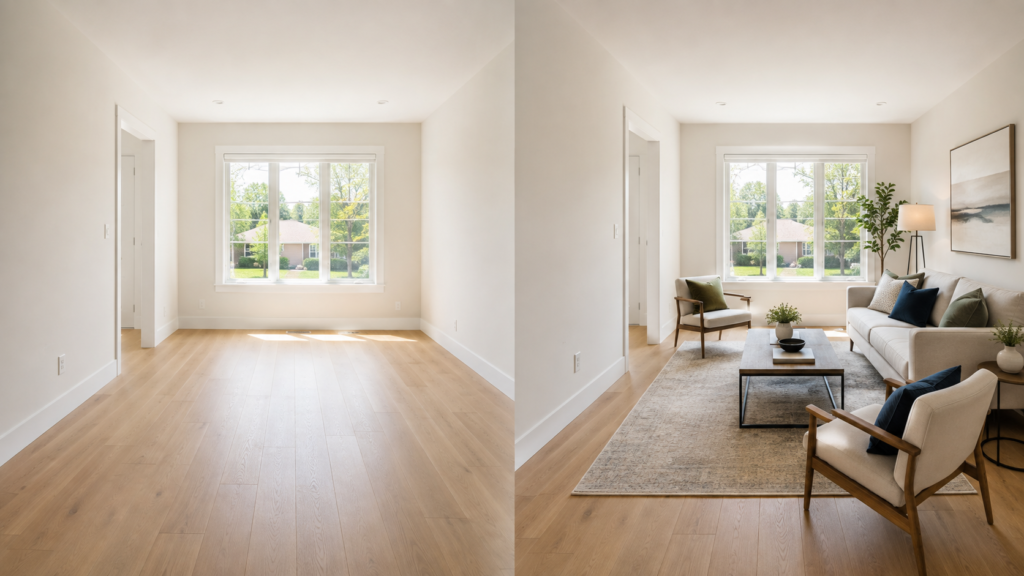
Short answer
Empty rooms photograph smaller because the camera and the human eye both need reference objects to judge scale. Without furniture there is nothing to compare the walls against, so the brain defaults to assuming the space is tight. Correctly scaled furniture gives the eye a measuring stick and the room reads larger.
It is counter-intuitive and it costs sellers money every day. The instinct is that removing furniture shows off the space. In photographs, the opposite happens almost every time.
Scale needs a reference
A wall on its own carries no information about size. A wall with a two-seater sofa against it tells the viewer exactly how wide that wall is, because everyone knows how big a sofa is. Take the sofa away and the brain has nothing to measure against, so it defaults to caution and assumes the room is small.
Empty rooms also expose every flaw
Bare floors show every scratch, patch and transition. Bare walls show every filled nail hole and paint inconsistency. Furniture and styling break those surfaces up and move the eye where you want it.
But over-furnished is worse
The opposite error is more common in occupied homes. Furniture that was correct for a previous, larger house makes rooms photograph cramped. This single issue is behind a large share of the apartments and townhouses that under-perform on their first campaign.
- A sofa too deep for the room eats the walking path
- A dining table for eight in a space that seats six reads as chaos
- Tall bookcases lower the apparent ceiling height
- Too many pieces means no clear focal point, so the eye does not settle
The practical rule
Each room needs one clear focal point, a visible walking path, and furniture in proportion to the room rather than to your previous home. If in doubt, remove the largest item rather than the smallest.